Travel Adapter Guide: What You Actually Need by Country
🧳 TripLab Testing Standard
We buy, pack, and travel with every piece of gear we recommend - then tell you exactly what to buy. Real reviews. No paid placements.
⚡ Quick Answer
For most travelers, one Paewok PD 2W Universal Adapter (~$16) covers 150+ countries and charges 4 devices simultaneously. You don't need a voltage converter unless you're bringing old hair appliances - modern electronics (phones, laptops, cameras) are all dual-voltage.
Adapters vs converters. Which plug types where. What actually blows up. All of it here.
The One Travel Adapter You Need (And Why Most Are Wrong)
Most travelers either buy the wrong adapter or skip it entirely and spend 20 minutes at the hotel front desk looking for one. The right move: one universal adapter covers every country you'll ever visit.
The Paewok PD 2W Universal Adapter ($16) works in 150+ countries, has 4 USB ports built in, and includes a safety fuse. You plug it into a UK, European, Australian, or US outlet - one adapter handles all of it. At $16 it's the single most practical travel purchase you can make before an international trip.
Plug Types by Region - Quick Reference
| Region | Plug Type | Voltage |
|---|---|---|
| USA, Canada, Mexico | Type A/B | 110V |
| UK, Ireland, Hong Kong, Singapore | Type G | 230V |
| Europe (most countries) | Type C/E/F | 220–240V |
| Australia, New Zealand | Type I | 230V |
| Japan | Type A | 100V - same plug, lower voltage |
| India, South Africa | Type D/M | 230V |
Will Your Electronics Work Abroad Without a Converter?
Almost certainly yes. Check the small text on your charger brick - if it says "Input: 100–240V, 50–60Hz" you're dual-voltage and only need an adapter (not a converter). Virtually every modern phone charger, laptop, camera, and tablet charger is dual-voltage. The only things that typically aren't: cheap hair dryers, curling irons, and older appliances rated for 110V only.
Plugging a 110V-only device into 220V without a converter = instant frying. Don't risk it. Check the label first.
Adapter vs Converter - What's the Difference?
🔌 Travel Adapter
Changes the plug shape so your device fits a foreign outlet. Does NOT change voltage. Cost: $15–$30. Who needs one: everyone.
⚡ Voltage Converter
Changes voltage from 220V to 110V (or vice versa). Heavy, expensive. Who needs one: people bringing old hair dryers or appliances not marked "100-240V".
Do you need a voltage converter? Check your device's power brick. If it says "100-240V, 50/60Hz" (virtually all modern phones, laptops, cameras), you only need an adapter - not a converter.
Plug Types by Region
| Region | Plug Type | Voltage |
|---|---|---|
| USA / Canada / Mexico | Type A/B | 110-120V |
| UK / Ireland / Hong Kong | Type G | 230V |
| Europe (most) | Type C/E/F | 220-240V |
| Australia / New Zealand | Type I | 230V |
| Japan | Type A (same!) | 100V - check devices |
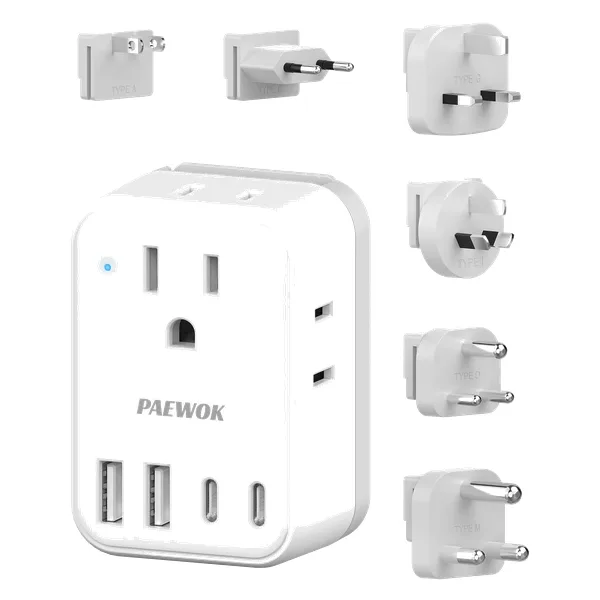
Paewok PD 2W Universal Travel Adapter - ~$16
Works in 150+ countries. 4 USB-A ports + 1 USB-C + AC socket. Built-in safety fuse. Fits in your palm. The only travel adapter most people ever need.
- ✓Works in 150+ countries
- ✓4 USB-A + 1 USB-C + AC
- ✓Built-in safety fuse
- ✓Compact palm-sized design
Paewok PD 2W Universal Adapter - Just Get This
150+ countries, 5 charging ports, $23. The only travel adapter you'll ever need.
Check Price on Amazon →Voltage Converters vs. Adapters: The Distinction That Matters
This is the most common point of confusion in travel electricity, and getting it wrong can mean a fried device. The short version: most travelers never need a voltage converter. Here's why.
Plug adapters change the physical shape of the plug so it fits the outlet. They do nothing to voltage. A US adapter to UK outlet just changes the plug shape - the voltage from the wall is still 230V coming through.
Voltage converters change the actual electrical voltage. The US uses 110-120V. Most of Europe, Asia, and Africa uses 220-240V. If you plug a US-only device into a 220V outlet (even with an adapter), you'll burn out the device - often immediately and visibly.
Why most travelers don't need a converter: Virtually every modern consumer device - phones, tablets, laptops, camera chargers, electric shavers, hair dryers made in the past 10 years - is dual-voltage (100-240V). This means it automatically handles both 110V and 220V. Check the fine print on your charger brick: it will say "Input: 100-240V~" if it's dual-voltage. If it says "110V only," you need a converter for that specific device. Laptop chargers, phone chargers, and camera chargers are universally dual-voltage. Hair straighteners, curling irons, and some older shavers are sometimes not.
I've been through 25 countries with the Paewok PD 2W universal adapter and never needed a converter. My phone charger, laptop charger, camera charger, and power bank have all been dual-voltage. The only time I've seen a converter actually needed was a colleague's older US hair dryer - the $12 adapter blew a fuse attempting to power it through a UK outlet.
Frequently Asked Questions
Will my phone charge safely in Europe?
Yes. Every modern smartphone charger is dual-voltage (100-240V). Just use a plug adapter - no converter needed. Check the fine print on your charger brick.
Can I use a universal adapter in Japan?
Japan uses Type A plugs (same as US) so US travelers don't need an adapter. However, Japan runs on 100V - while most modern devices handle this fine, check yours.