Best Travel Umbrella 2026: Windproof, Compact, and Actually Durable
🧳 TripLab Testing Standard
We buy, pack, and travel with every piece of gear we recommend, then tell you exactly what to buy. Real reviews. No paid placements.
⚡ Quick Answer
The Repel Windproof Travel Umbrella (~$30) is the best travel umbrella for most people. Nine fiberglass ribs, a double-vented canopy, and auto open/close. I've had it for 3 years and it has not flipped once. On a tight budget, the Rain-Mate (~$14) uses the same windproof concept for half the price.
Most Travel Umbrellas Are Garbage
I've had 4 travel umbrellas break on trips. Not at home. On trips, when I needed them. One snapped clean in half on a windy corner in Edinburgh. Another flipped inside-out in a 20mph crosswind in Tokyo and never came back. One lasted exactly 11 days before a spoke punched through the canopy fabric.
The problem is that most umbrellas, even ones marketed as "travel umbrellas," are built with cheap steel ribs and no venting. When a real gust hits a solid canopy, the wind has nowhere to go, so it inverts the whole thing. The ribs bend. The spokes twist. You're left holding a broken flower in the rain.
The umbrellas on this list are different. They use fiberglass ribs that flex and spring back instead of bending permanently, and most have vented canopies that let wind pass through instead of catching it. The Repel hasn't flipped once in three years of hard use. That matters more than price, weight, or anything else.
What to Look For in a Travel Umbrella
Before you buy anything, understand the specs that actually matter:
Rib Count (8 or 9 is best)
More ribs means a more even frame under stress. Standard umbrellas have 6 ribs. Travel umbrellas worth buying have 8 or 9. The Repel uses 9 fiberglass ribs. That extra structure distributes wind load instead of concentrating it on one or two spokes that then snap.
Venting (the single most important feature)
A double-vented canopy has a small gap near the top that lets wind escape upward rather than lifting the whole canopy. This is the difference between an umbrella that stays open at 35mph and one that immediately inverts. If an umbrella doesn't mention venting, assume it has none.
Auto Open/Close
A one-button auto open/close mechanism means you can deploy it with one hand while holding a bag or phone with the other. This sounds minor until you're fumbling with a manual umbrella in a downpour. All four picks on this list have auto open/close.
Folded Length and Weight
For carry-on travel, you want a folded length under 12 inches. Most compact umbrellas hit 10 to 11 inches, which fits in a backpack side pocket. Weight under 1 pound (16oz) is the goal. The Totes Auto Open/Close weighs 11oz, which is impressively light for a full-function umbrella.
Canopy Size
A 42-inch canopy covers one person adequately, keeping your shoulders dry in a straight-down rain. If you're traveling with a partner and want to share, the G4Free Golf Umbrella's 62-inch canopy is the right call. Anything smaller than 40 inches and you're keeping your head dry while your shoulders get soaked.
The 4 Best Travel Umbrellas for 2026
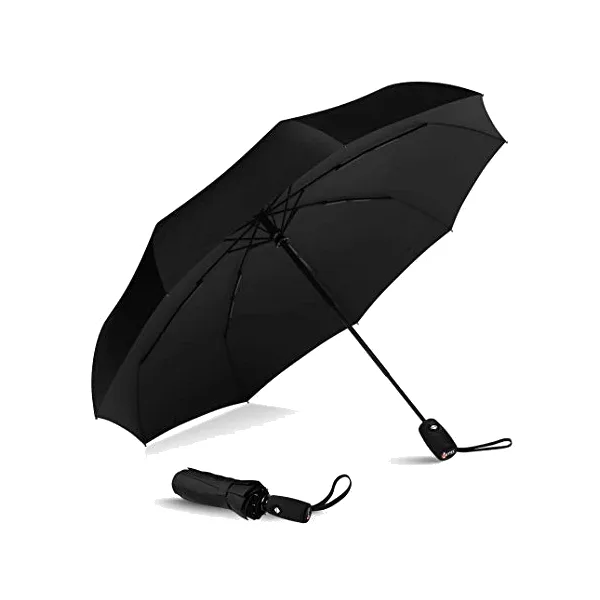
Repel Windproof Travel Umbrella - ~$30
This is the one I've trusted for 3 years. Nine fiberglass ribs, a double-vented canopy rated for winds above 35mph, and a solid auto open/close button. It weighs about 14oz, folds to 11 inches, and the canopy is 42 inches when open. The Teflon coating sheds water cleanly so you're not dealing with a dripping mess after folding it up. I've used it in London, Tokyo, New York, and Edinburgh. It has not flipped once.
The handle grip is rubberized and comfortable to hold in a sustained rainstorm. The carry sleeve is included and actually keeps the umbrella contained when packed. At $30 it's not the cheapest option, but it's the last travel umbrella you'll need to buy for a few years.
- ✓ 9 fiberglass ribs, rated for 35mph+ winds
- ✓ Double-vented canopy
- ✓ Auto open/close, one-handed operation
- ✓ 42-inch canopy, 11-inch folded length
- ✓ Teflon water repellent coating
- ✗ Slightly heavier than some budget options at 14oz
Rain-Mate Compact Travel Umbrella - ~$14
The Rain-Mate is what you buy when you want a windproof travel umbrella but can't justify $30. It uses the same core design concept as the Repel: a vented canopy and reinforced ribs that flex in wind instead of snapping. The Teflon water repellent coating works well in steady rain. The auto open/close is smooth.
At $14, my expectations were low. After using it on a trip to the Pacific Northwest last fall, I was genuinely impressed. It handled gusts I would have expected to flip any sub-$20 umbrella. It's not quite as solid-feeling as the Repel and I wouldn't rate it the same for sustained heavy wind. But for the price it's a serious overperformer. Keep one as a backup or buy it as your primary if budget is the constraint.
- ✓ Double-vented windproof canopy
- ✓ Teflon water repellent coating
- ✓ Auto open/close
- ✓ Under $15, ships free with Prime
- ✗ Not quite as wind-resistant as Repel in extreme gusts
- ✗ Canopy fabric feels slightly thinner
Totes Auto Open/Close Compact Umbrella - ~$20
Totes has been making umbrellas for decades and this compact model is their travel-focused design done right. The standout feature is how effortlessly it opens with a single thumb press on the button, even with gloves on. It weighs just 11oz, making it the lightest option on this list. The canopy is 43 inches when open and the folded length is about 11 inches.
I reach for this one when I know I'll be switching between holding things and holding an umbrella repeatedly. Moving through a crowded market in the rain, navigating public transit, or juggling luggage and a phone. The one-handed deploy is genuinely useful in those situations. It's not rated for the extreme winds the Repel handles, but in typical city rain it performs well and the light weight means you actually carry it instead of leaving it in the hotel room.
- ✓ 11oz, the lightest pick on this list
- ✓ Smooth, effortless one-button open/close
- ✓ 43-inch canopy diameter
- ✓ Totes brand reliability, easy to find replacement
- ✗ Not rated for high-wind conditions like the Repel
- ✗ No vented canopy
G4Free Large Golf Umbrella - ~$25
The G4Free is the outlier on this list. It's not ultra-compact. It's not trying to be. The 62-inch canopy is designed to cover two people or one person in a heavy sideways rain where a 42-inch canopy just isn't enough. If you're traveling with a partner and you want one umbrella that keeps both of you genuinely dry, this is the one.
The frame is fiberglass reinforced and handles wind well for its size. The double-vented canopy is a welcome feature at this diameter since a solid 62-inch canopy would act like a sail in any real wind. It's rated for weather-resistant use, meaning it can take sustained rain without the seams soaking through. The tradeoff is size. It folds larger than a compact umbrella and weighs more. If you're doing carry-on only with a tight packing setup, plan for it. For checked bag travelers or anyone who doesn't mind a slightly larger umbrella, the coverage is worth it.
- ✓ 62-inch canopy, covers two people comfortably
- ✓ Double-vented windproof design
- ✓ Fiberglass reinforced frame
- ✓ Great value at $25 for the size
- ✗ Not compact, folds larger than standard travel umbrellas
- ✗ Heavier than the other picks
Repel Windproof Travel Umbrella
Nine fiberglass ribs, double-vented canopy, 3 years without a single flip. The one I actually carry.
Check Price on Amazon →Side-by-Side Comparison
| Umbrella | Price | Ribs | Canopy | Weight | Vented | Auto O/C |
|---|---|---|---|---|---|---|
| Repel Windproof | ~$30 | 9 fiberglass | 42 in | 14 oz | Yes | Yes |
| Rain-Mate Compact | ~$14 | 8 fiberglass | 42 in | 13 oz | Yes | Yes |
| Totes Auto O/C | ~$20 | 8 | 43 in | 11 oz | No | Yes |
| G4Free Golf | ~$25 | 8 fiberglass | 62 in | ~22 oz | Yes | Yes |
Which One Should You Buy?
For most travelers, buy the Repel. It's $30, it's survived 3 years of real travel, and the 9-rib fiberglass frame with double-vented canopy is the combination that actually works in wind. I stop recommending things when they disappoint me. The Repel hasn't.
If you're on a strict budget, the Rain-Mate is a serious umbrella at $14. Don't let the price fool you into thinking it's a throwaway. It uses the right design principles and outperforms everything else in its price range. I'd take it over any $25 umbrella at an airport kiosk.
If you prioritize low weight and effortless single-handed deployment, the Totes at 11oz is the lightest pick here and opens about as easily as any umbrella I've used. Just know it doesn't have the vented canopy of the Repel or Rain-Mate.
If you're traveling with a partner or heading somewhere with real sustained rain (monsoon season, Irish spring, a week in Bergen), the G4Free's 62-inch canopy is the right call. It's not compact, but it actually covers two people.
Frequently Asked Questions
What makes a travel umbrella windproof?
Two things: a double-vented canopy that lets wind pass through instead of catching it, and a high rib count (8 or 9 ribs) using fiberglass instead of steel. Steel ribs snap. Fiberglass ribs flex and spring back. The Repel Windproof Travel Umbrella combines both features and handles winds above 35mph without inverting.
How compact should a travel umbrella be?
For carry-on travel, look for a folded length under 12 inches. Most compact travel umbrellas collapse to 10 to 11 inches, which fits in the side pocket of a travel backpack or inside a toiletry bag. The Repel and Rain-Mate both fold to about 11 inches.
Are cheap travel umbrellas worth buying?
Cheap generic umbrellas from airport kiosks are not. They have steel ribs, no venting, and flip inside-out in any real wind. The Rain-Mate at around $14 is the exception. It uses a windproof double-vented design and Teflon-coated canopy for less than half the price of premium options. That's the lower limit I'd go.
Can one travel umbrella cover two people?
Standard compact travel umbrellas have canopies around 42 inches in diameter. That covers one person adequately. If you want to share with a travel partner, the G4Free Large Golf Umbrella has a 62-inch canopy and covers two adults comfortably. It is larger and heavier, but still around $25.