Best Crossbody Bag for Travel 2026: Anti-Theft, Lightweight, and Actually Stylish
Updated August 2026 · By TripLab
Here at TripLab, the crossbody question comes up constantly. After testing dozens of travel bags across destinations from Naples to Bangkok, the answer keeps pointing the same direction: a well-worn crossbody across the chest is the smartest everyday carry format for city travel. In Naples, one of our testers had a bag hanging loosely off a shoulder at a busy intersection - outer pocket zip pulled open without a sound felt. Everything was still inside, barely. A few more seconds of distraction and it would have been a police report instead of pizza. After that trip, every shoulder tote was retired for travel in favor of crossbody bags worn tight across the chest.
The crossbody format solves a specific problem: keeping your gear accessible without making it easy for someone behind you to grab it. Worn correctly, the bag sits against your torso, the zipper faces inward, and your arm naturally rests over it in crowds. It is not a perfect defense against determined thieves, but it makes casual opportunistic theft significantly harder. The tradeoff is capacity. Crossbody bags are compact by design, usually 3 to 6 liters, so if you need to carry a full-size water bottle, a laptop, and a rain jacket, you will feel the squeeze. Knowing that upfront helps you pick the right bag rather than the one that looks good in photos.
Quick Picks
What Makes a Crossbody Good for Travel
Not every crossbody bag deserves to come with you overseas. Here are the four features that separate a genuinely useful travel crossbody from one that will frustrate you within an hour of landing.
Slash-Resistant Strap or Body
High-end anti-theft bags from brands like Travelon and PacSafe use wire mesh inside the strap and body panels to resist cutting. Most everyday crossbodies skip this. If you are going to high-theft areas, look for reinforced straps. For most city travel, a thick nylon strap with a metal clasp is enough to deter casual theft since most thieves want quick grabs, not committed cutting.
RFID Blocking Pocket
A lined pocket that blocks radio frequency signals from reaching your cards. Whether you actually need this in 2026 is debatable (more on that in the callout below), but it adds no weight and no bulk. Worth having as a checkbox, not worth paying extra specifically for it.
Weight Under 0.5 lbs Empty
A crossbody sits on one shoulder and one side of your torso all day. Even a modest 0.4 lb bag loaded with a phone, passport, snacks, and a water bottle gets heavy fast. Bags over half a pound empty will ache by hour four of a walking tour. Look for nylon or ripstop construction and skip heavy leather or canvas options if you are covering serious ground.
Easy-Access Main Compartment
The zipper should open wide and allow you to see and grab things in one motion, not require you to dig around blind. A bag you have to take off and open like a treasure chest defeats the purpose of a crossbody. Look for a main compartment that opens at least 180 degrees and has an interior organizer so your passport is not buried under lip balm.
The RFID Blocking Question
RFID blocking protects against contactless card skimming, which is when a bad actor with a reader device walks near you and wirelessly reads your credit card number. It sounds scary, and it was a real concern when contactless-only cards became common in the early 2010s.
In 2026, most banks use dynamic transaction codes on contactless payments, meaning a captured number is useless for a second transaction even if someone did skim it. The actual reported cases of RFID skimming in the wild are extremely rare, and most researchers who have tested it in public spaces found it nearly impossible to execute without the victim noticing.
Bottom line: RFID blocking is a bonus feature, not a reason to choose one bag over another. If it is included, great. Do not pay $30 more for it as a selling point. Your bigger card security risk is phishing and data breaches, not someone scanning your pocket at a bus stop.
Our Top Pick
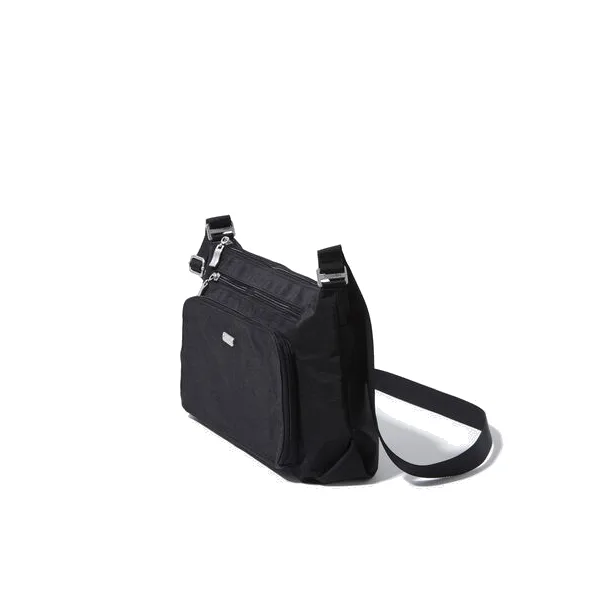
Baggallini Multi Pocket Crossbody
The TripLab team has watched this bag appear on virtually every city trip over the past three years. It is not the flashiest option on the market, but the Baggallini Multi Pocket Crossbody nails the fundamentals better than bags costing twice as much. The nylon body is water-resistant and wipes clean after a market day. It weighs just 0.38 lbs empty, which means it stays comfortable through five hours of walking without the shoulder soreness that heavier bags cause. The strap drops to about 26 inches fully extended, which works for most heights to position the bag at hip level. The interior layout includes a main zippered compartment with a dedicated passport sleeve, a key clip, a phone pocket, and a separate front zip compartment for transit cards or sunglasses. The RFID-blocking pocket is in the main body, not an awkward exterior flap. Capacity sits around 4 to 5 liters, which is honest about what a crossbody can carry: your daily essentials, not your entire trip.
- ✓Weighs 0.38 lbs empty - one of the lightest options in this category
- ✓Water-resistant nylon body holds up in light rain and dusty markets
- ✓Dedicated RFID-blocking pocket, passport sleeve, and key clip
- ✓Multiple exterior and interior pockets for organized access on the go
- ✓Adjustable strap drops to 26 inches for crossbody or shoulder carry
- ✗Compact 4 to 5L capacity; not suitable if you carry a large water bottle or tablet
- ✗No slash-resistant strap or locking zipper for high-risk areas
Other Crossbodies Worth Considering
The Baggallini is the default pick for most travelers, but it is not the only option worth your attention.
Away built its reputation on clean, minimal design, and the Everywhere Bag carries that aesthetic into the crossbody/sling category. If you are heading to a city where you want to blend in rather than look like you are on a hiking trip, the Away is significantly more polished than most nylon options. The single-compartment layout keeps things simple: there is a main zip body, a front flat pocket, and an interior card slot. The strap is padded and adjustable, which helps on longer city walks. At around 4 liters, it holds the essentials but not much more. We have used it as a personal item on flights when the carry-on is already at capacity. The tradeoff is the price point. At $95 for what is ultimately a small bag with limited organization, you are paying partly for the brand and the design language. If those things matter to you on this trip, it is worth it.
View on Amazon →Technically not a crossbody, but worth mentioning for travelers who are on the fence. The Herschel Retreat is a compact 19.5L daypack that sits closer to the body than most backpacks and has a relatively slim profile. When traveling somewhere cold or doing a day trip that involves a jacket, rain gear, and more than just a passport, this is what the TripLab team reaches for instead of a crossbody. The security tradeoffs are real: a backpack on your back is harder to monitor than a crossbody on your chest. But for pure carrying comfort over five-plus hours, backpacks beat crossbodies every time.
View on Amazon →Osprey Fairview 40
$160Not a crossbody at all, but if you landed on this page because you need a travel bag and you are not sure what format fits your trip, the Osprey Fairview 40 is the answer when the trip is longer than a few days and a crossbody will not cut it. It is a 40L women-specific travel pack designed to carry on most airlines as overhead luggage. It has a dedicated crossbody daypack that detaches and can be used separately, which effectively gives you both formats in one system. Significantly larger investment at $160, but a different category entirely.
View on Amazon →What About Anti-Theft Crossbodies?
If you are traveling to destinations with a higher pickpocket risk, like busy tourist corridors in Rome, Barcelona, or Marrakech, purpose-built anti-theft crossbodies are worth a look. The two most credible brands in this space are Travelon and PacSafe.
Travelon makes a wide range of bags with features like slash-resistant strap cores (a steel cable runs inside the nylon strap so it cannot be cut), locking zipper clips, and RFID-blocking card pockets. Their crossbody bags typically run $40 to $65, which is good value for the protection features included. The tradeoff is that the reinforcement adds weight. Even their lightest bags come in closer to 0.6 to 0.7 lbs empty, which you feel by the afternoon.
PacSafe positions itself at the higher end of this category. Their Citysafe series uses Ecomesh (a polyethylene mesh embedded in the bag panels) and turn-and-lock security hooks designed to attach the strap to fixed objects. PacSafe bags are genuinely impressive from an engineering standpoint. They are also heavier and more expensive, typically $90 to $130 for a basic crossbody. For most travel, that investment is more than you need. For high-risk destinations or solo travelers in unfamiliar cities late at night, the peace of mind has real value.
Our honest take: if you are going somewhere tourists commonly get pickpocketed and you are already anxious about it, buy a Travelon. The weight penalty is worth it for the confidence. For normal city travel where awareness and positioning do most of the work, the Baggallini is lighter, less expensive, and just as practical.
When a Crossbody Is the Wrong Choice
A crossbody bag is not the right tool for every trip. Here is when you should reach for something else:
- › Long hiking or active days. Carrying 4 to 6 pounds of gear on one shoulder for eight hours damages your posture and creates real muscle fatigue. A hip pack distributes weight across your hips. A backpack spreads it across both shoulders. A crossbody with a heavy load does neither.
- › Traveling with young kids. You need both hands more than you think. Kids require constant grab-and-hold moments, and a crossbody swings around at the worst times. A backpack or a waist pack keeps your hands free and your gear secure.
- › Carrying more than 6 pounds of gear. Compact cameras, heavy lenses, water bottles over 20 oz, or anything involving medical gear or a tablet pushes the capacity and weight limits of any crossbody. Look at a small daypack or hybrid sling instead.
- › Very short strap adjustability. If you are taller than average or have a larger torso, some crossbodies do not extend long enough to sit at your hip rather than your armpit. Always check the maximum strap drop before buying. Most should extend to at least 26 to 28 inches for comfortable crossbody wear on taller frames.
Frequently Asked Questions
What size crossbody bag is best for travel?
For day trips and city walking, look for a crossbody in the 3 to 6 liter range. That is enough for a passport, phone, cards, a compact camera, a small water bottle, and a light layer. Anything bigger starts to feel like a shoulder bag and loses the security advantage of wearing it across your chest.
Is RFID blocking worth it in a travel crossbody?
Real-world RFID skimming is rare in 2026, and most modern credit cards use chip-and-pin rather than contactless-only. That said, RFID-blocking pockets add no weight or bulk, so there is no reason to avoid them. Just do not pay a premium specifically for that feature.
Can I use a crossbody bag as a personal item on a plane?
Yes. Most crossbody bags fit easily under the seat in front of you since they are compact by design. If you are also bringing a carry-on, the crossbody goes under the seat and your roller or backpack goes overhead. Just check your airline's personal item size limit, which is typically around 18 x 14 x 8 inches.
How do I wear a crossbody bag to prevent theft while traveling?
Wear the bag across your chest rather than on your side or back. Keep the zipper facing inward toward your body. In crowded areas like markets or metro stations, hold the bag in front of you with one hand. Avoid bags with external pockets on the back or bottom where someone behind you could unzip without you noticing.
What is the difference between a crossbody bag and a sling bag for travel?
A crossbody bag typically has a longer adjustable strap that lets it hang on your hip or across your chest. A sling bag usually has a single wider strap worn diagonally and sits flatter against your back or chest. Both work well for travel. Slings tend to hold slightly more and distribute weight better on longer walks. Crossbodies are easier to swing around to access quickly.